The Better Way to Print Shipping Label with QR and Barcode Template for Excel
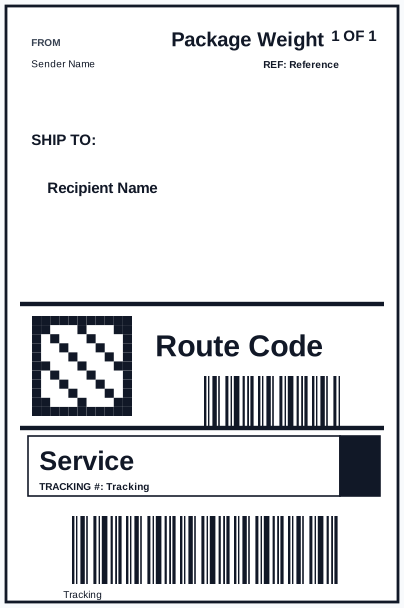
Shipping Label with QR and Barcode Template for Excel gives you a higher-quality starting point for shipping labels that need address readability, scanner reliability, and a lookup QR code on the same 4x6 label. It is designed as a complete package: spreadsheet headers, mapped layout fields, scannable code elements, thumbnail preview, and SEO page content all describe the same real workflow. For multi-piece jobs, Formula Builder can show clear copy text such as Box 1 of 10, Carton 2 of 8, or Pallet 1 of 3 when the imported data includes copy columns.
Instant Setup
Don't waste time formatting Word tables. This template is pre-configured with the correct margins and barcode fields.
Batch Processing
Link your Excel data and print 1 or 10,000 labels with one click. Every label is uniquely populated from your spreadsheet.
Vector Quality
Output high-resolution PDF or direct-to-printer data. Barcodes remain 100% sharp for perfect scanner reliability.
How to Use this Shipping Label with QR and Barcode Template for Excel Guide
- Open the XLSX sample and review the mapped headers: Sender Name, Sender Address, Recipient Name, Street Address, City, Postal Code, Country, Package Weight, Reference, Service, Route Code, Tracking, QR URL.
- Replace the sample rows with one production label per row.
- Format scan values as Text before import, especially Tracking and QR URL.
- Open the matching LabelFlow Pro JSON layout and verify that each barcode, QR, and text element uses the expected field.
- Print a small test batch and scan every code type used by the template: QR, CODE128.
Suggested Excel Columns
- Sender Name - mapped field used by the template layout and workbook
- Sender Address - address line kept separate for cleaner wrapping
- Recipient Name - name text printed on the label
- Street Address - address line kept separate for cleaner wrapping
- City - location field used by the layout
- Postal Code - location field used by the layout
- Country - location field used by the layout
- Package Weight - mapped field used by the template layout and workbook
- Reference - reference value used for lookup or scanning
- Service - mapped field used by the template layout and workbook
- Route Code - mapped field used by the template layout and workbook
- Tracking - warehouse location field used for sorting and scanning
- QR URL - QR code source value such as a URL, ID, or reorder link
Keep these fields aligned with the template workbook and the mapped fields in the LabelFlow Pro layout. Clean structure keeps imports predictable and reduces manual cleanup before printing.
Prepare clean source data
Keep Sender Name, Sender Address, Recipient Name, Street Address in separate columns so the label can wrap, scan, and reprint predictably.
Protect code fields
Treat Tracking and QR URL as exact text. This prevents Excel from removing leading zeros, shortening long values, or changing URLs.
Check physical readability
Preview the longest realistic values and confirm that every code has enough quiet zone, contrast, and printed size for your printer DPI.
Approve the package
Use the XLSX, JSON layout, SVG preview, and HTML guide together. If one field changes, update all package pieces before publishing.
Common Mistakes
- Using one address cell instead of separate address fields.
- Encoding a QR URL that does not match the printed tracking number.
- Letting Excel alter tracking numbers or references before import.
- Printing the 4x6 label with browser scaling enabled.
- Skipping a scan test with the free barcode scanner before production printing.
When This Template Is Useful
- Small warehouse parcel dispatch
- Courier handoff labels with internal order lookup
- Return labels that need both tracking and QR data
- Batch shipping labels generated from Excel or CSV rows
This is a strong candidate for a short how-to video: How to print shipping labels with QR and barcode from Excel.
Which code types are included?
This layout includes QR, CODE128 elements mapped to the workbook fields.
Can I remove one of the codes?
Yes. Remove the matching barcode or QR element in the designer, then remove or ignore the related Excel column.
What should I test before production printing?
Print on the final stock, scan each code, and verify that the human-readable text still matches the encoded value.
Can this template use Formula Builder counters?
Yes. Keep the Excel headers aligned with the mapped layout, then add a Formula Builder text object for counters such as Box 1 of 10, Pack 1 of 10, Carton 1 of 8, or Pallet 1 of 3.